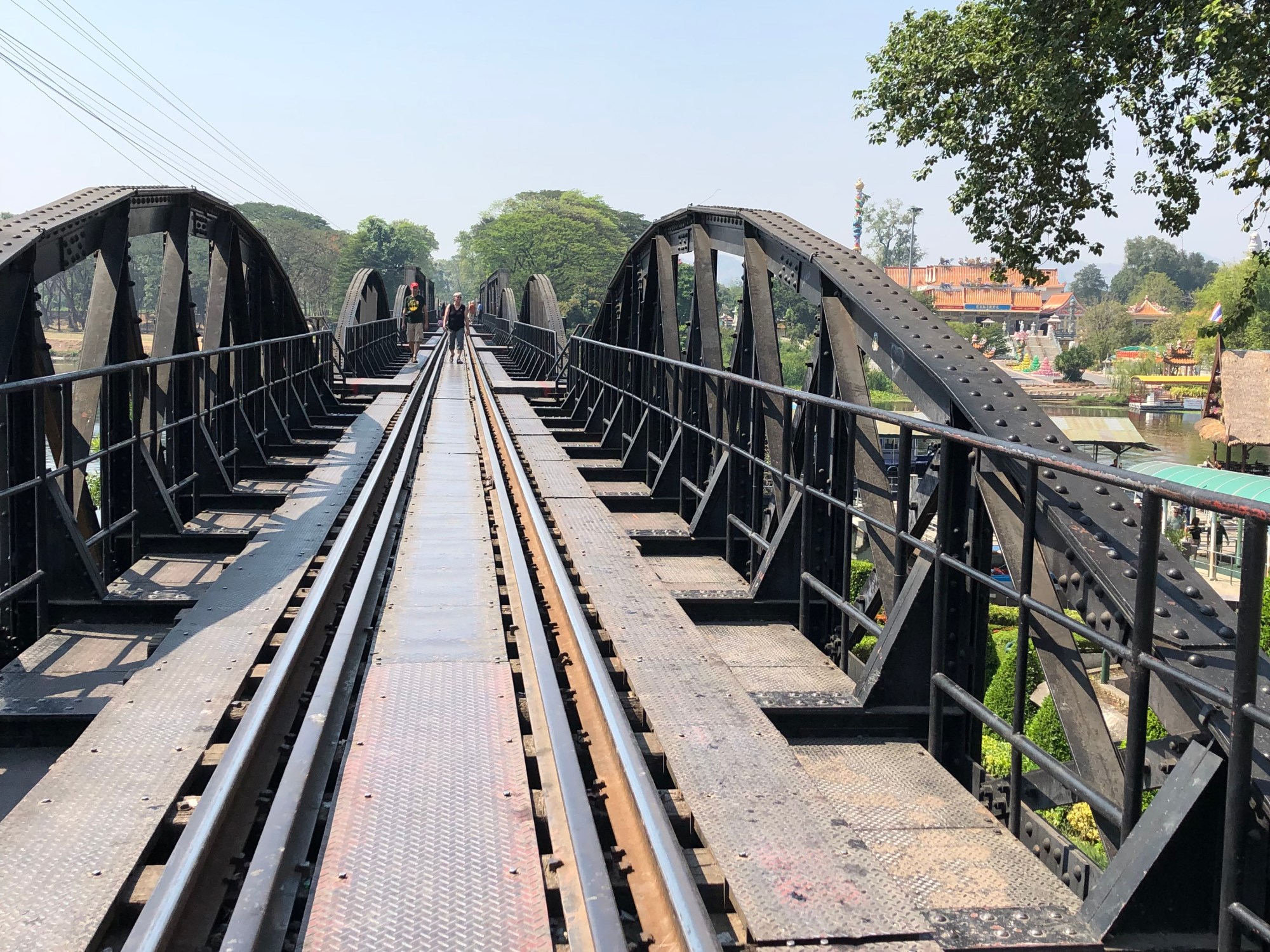
After the hustle & bustle of Bangkok (again..) it was time for me to go back in time and learn more about what happend during the second world war in Thailand. Or more specifically: the history of the Burma Railway.
I can’t actually recall ever learning about this in school even though it is very much tied to Dutch history too. Now i’m not sure it that’s saying something about my memory or Dutch education… i’ll let you guys decide on that 🙂
We started our trip by going to Death Railway museum and memorial garden. I did not know the horrific story of the railway and boy did it shock me..
Brief summary of what the Death Railway is for those who may not know:
The Death Railway was built during the 2nd World War by the labor of the war prisoners forced by the Japanese troop.
The Death Railway was a route through Thailand that ended at the border of Burma.
The railway got it’s name after it’s brutal history. There is a saying that: “the number of the railways length in metres, is equal to the numbers of the death during the labor used to build this railway”.
The Death Railway is 415 kilometers altogether with 37 stops. This railway was completed on 25th October 1943.
During the building period, there were many POW’s (prisoners of war) who suffered by being tortured and unfortunately most had died (circa 100.000 deaths) by the brutality they endured by the Japanese army.
The history is still unforgettable among the people’s heart today. Nowadays, some parts of the Death Railway is open to the tourists who visit and locals travelling from town to town. However, there are some parts that were deserted since Japan lost the war and are no longer used.
It’s story is long with so much detail that I cannot tell fully nor would I do it justice. So if you’d like to know the full story please read it here:
https://www.britannica.com/topic/Burma-Railway
The museum showcased it’s history with also some of the tools and original wood slabs that the POW’s used.
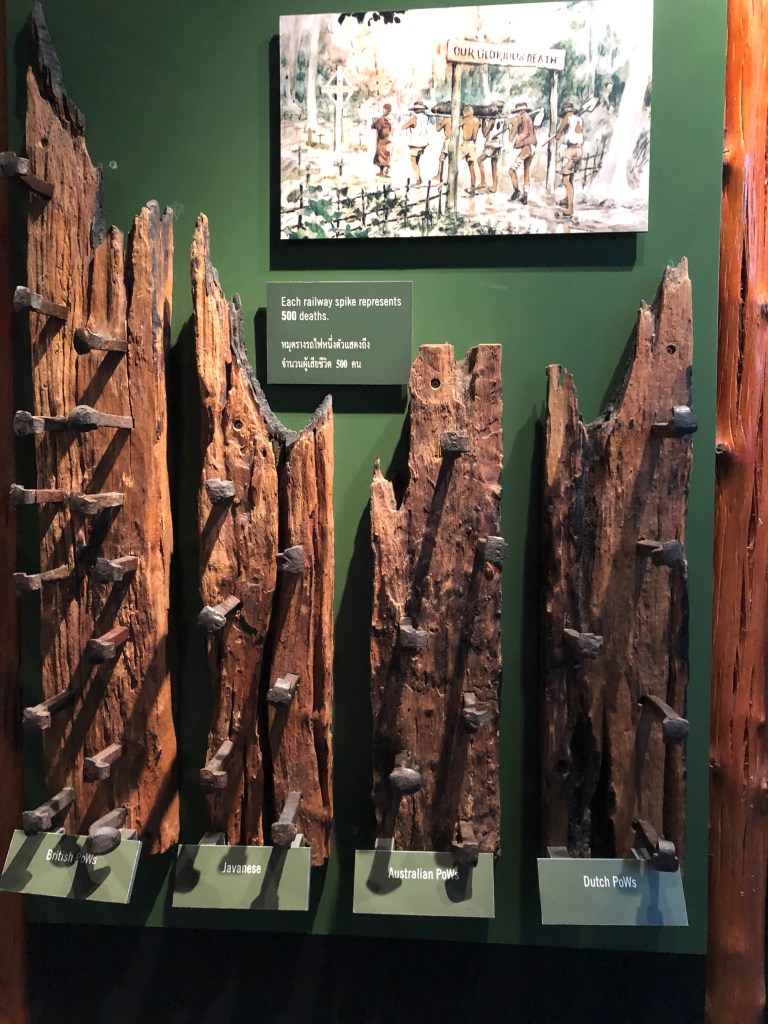
*Each railway spike represents 500 deaths per nationality.*
They had photo’s of the prisoners, drawings the prisoners themselves had made and also a few movie clips from survivors sharing their experiences.
It was unsettling and my heart sank every time I read a new sentence or saw a new photo.
After the museum we visited the memorial garden. They had laid it out beautifully and filled it with flowers so the butterflies and bee’s could visit those who had passed away during the construction of the railway.
I walked along and read every headstone I passed. Wishing them all peace and love where-ever they may find themselves now.
Many Dutch names were there as-well which made me think of how much this must have effected our country and how much of a shame it is that I never learned this history at school.
After a few tears in my eyes (blaming the suncream for that from now on) and swallowing hard it was time to head back to the bus which took us to the Bridge Over River Kwai.
This bridge is the most famous one on the whole railway. It was built fully out of wood and should have taken five years to construct, but because the Japenese made the POW’s work so hard and in such harsh ways it only took them 16 months to complete it.
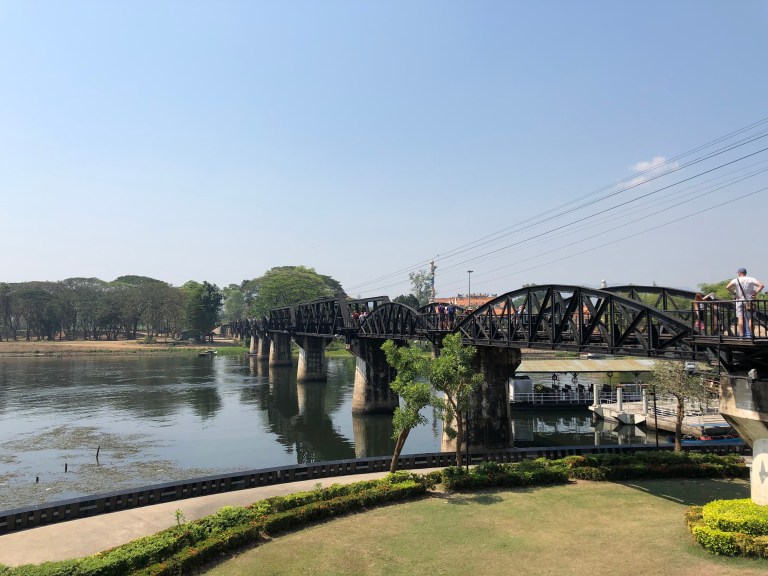
This just goes to show again how little the Japanese cared for human life.
During the war the bridge was bombed twice. After the first bombing the pow’s had to repair it again in a short period of time.
During the second air-raid in 1945 the bridge was again bombed and destroyed much of the railway which put the railway out of service until the war ended.
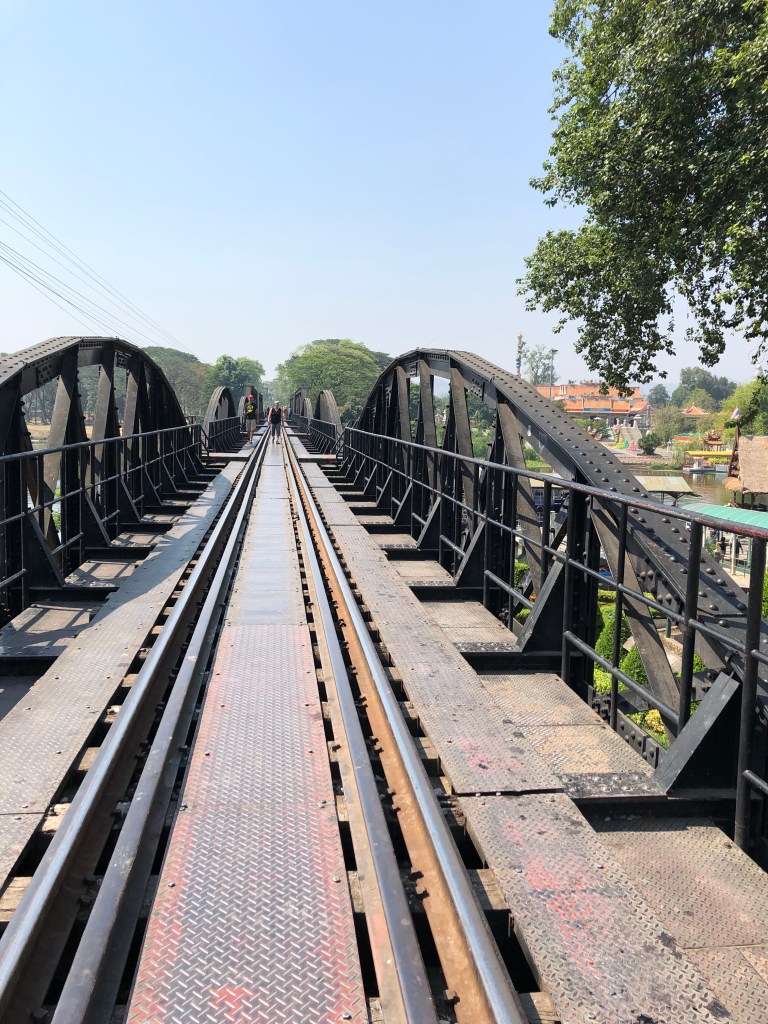
Long after the war ended the bridge was rebuilt and now there is a train that goes over it and you yourself can walk over it.
It is a magnificent bridge, even though a little eerie due to it’s past but it’s a definite must see if you’re in Kanchanaburi.
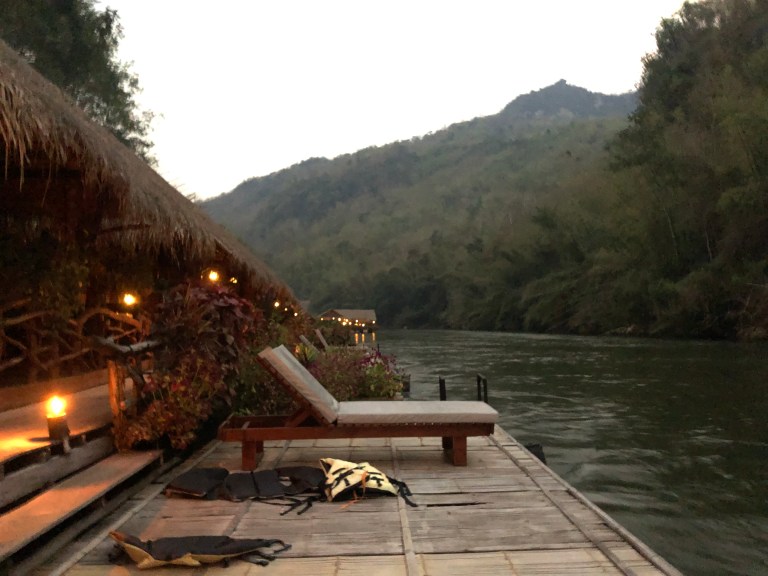
After the bridge we went back to the bus which then took us to our hotel. This hotel is not your most common hotel as it was a jungle raft made mostly of bamboo that floats on the river Kwai.
The river Kwai is gorgeous and so is the hotel floating on it. Each room had a little floating porch which was decorated with many flowers.
The hotel i’m staying at is the original river raft hotel on the river Kwai which was built in the 70’s by the Mon people.
The Mon people come from a small village just behind the hotel. The story of the Mon people is that they originated from Burma until Burma took over and drove the Mon’s out. These people are now living all over Asia but the population is unfortunately unknown. This because the children get the nationality of where they were born.
The children in this village go to a Thai school to learn Thai and everything else from monday-friday.
On the weekends they get lessons in their village school so that they keep their own language in tact and also learn about the Mon history.
The village is beautiful and very well kept. They have an elephant as well, as-if it were their pet dog.
The people of the Mon village work at the hotel as receptionists, cooks, cleaners to barmen & waitresses. Who are all exceptionally kind and helpful even if they do not speak English.
The hotel does have one downfall which is also a blessing in disguise; no electricity.
I had charged my phone and powerbank but three days was pushing it… So most of my time I turned my phone off which really made me tune into what I was seeing and doing. Plus it gave me time to let the whole history lesson sink in.
As you have learned by now I can get pretty emotional, pretty quickly. So whenever I see something upsetting, my body soaks it up like a sponge and I need some time to figure it all out and give it a place. Sounds tiring, I know.
But time at the river raft gave me just that. Time and a place to let it all sink in and then let go.
In addition that this, I was able to take in nature’s beauty properly that surrounded me, now can’t really complain about that can I ?!
I had a room next door to a Dutch couple and on the other side a German couple, who were all really lovely people.
Once we arrived at our rooms we all got changed into our swimming cozzies and jumped into the river.
Now the river was very fast flowing so we went all the way up to one side of the hotel, jumped in and got swept down the river – rather quickly – to the other end where we had to climb out.
If you didn’t make it to the last ladder then you were pretty much screwed and just kept bobbing along the river, so it was rather more exciting than it might sound haha.
Afterwards we relaxed, I napped surprise surprise .. but you can’t blame me i’d been up since 05:00 😵, to then go to dinner together.
Dinner was yum! We got served rice with four or five different plates of food; curries to grilled or boiled veggies in delish sauce.
Drool worthy food. 🤤
After dinner we saw a traditional Mon & Burmese dance routine. All I can say about this was that was: loud.. very loud but the costumes were pretty and even though I didn’t understand the dance moves, they were very interesting.
After the show I hit the sack and was up bright and early for our next destination. This morning we were going to the Hell Fire Pass.
As the name suggests, here too was not a pretty story but very interesting and worth to be told too!
The Hell Fire Pass is where the POW’s of the second world war had to cut through rocky mountain to let the train pass through.
Now this rocky terrain was in the middle of the jungle, humid and hot and worst of all, they had no proper tools or electricity so everything was done by hand.
The Japanese thought progress was too slow and so made the workers do ‘speedo’ time which translates to 24hour work days.
The name Hell Fire Pass came by the horrific ordeals these POW’s went through. Because of the conditions they were in: rotten and not enough food, illnesses such as malaria & cholera spread, the unbearable heat and the 24 hour work day they found themselves in, was a literal hell for them. Because they also had to light fires to see what they were doing during night time, it felt like they were in a hellfire.
Even though in the morning it had already hit the number 30 on the thermometer, it was bone chilling to walk through the pass.
There were small flags in some of the cracks and creases in the mountain walls and a memorial sat at the end.
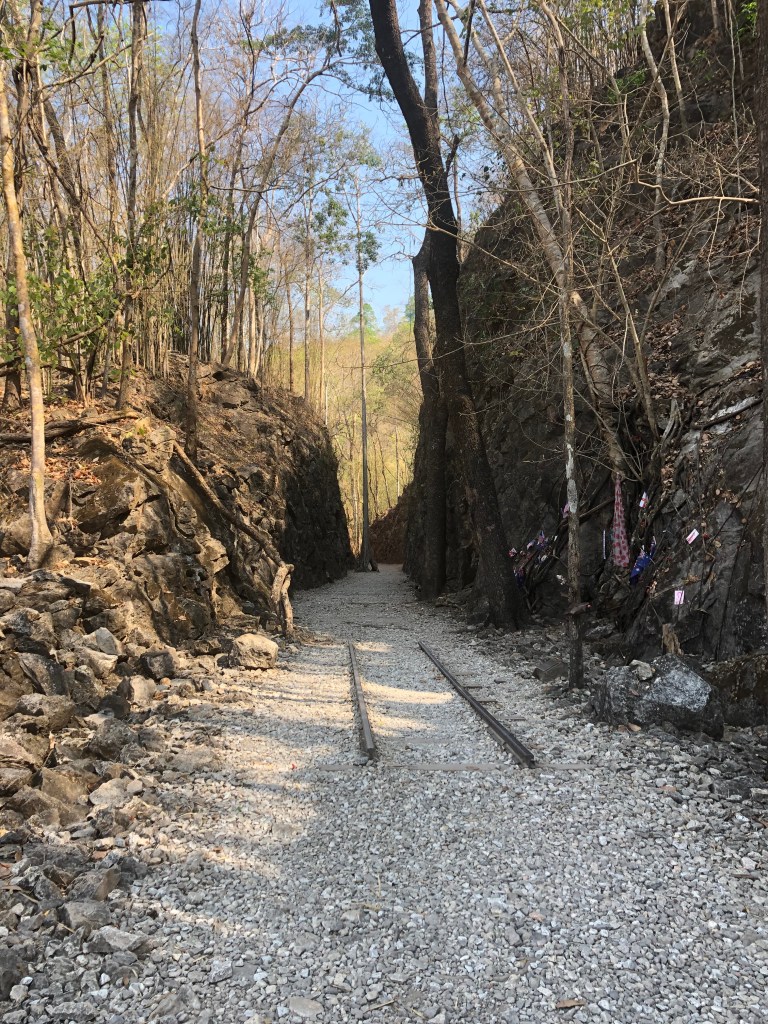
After hearing the story from our guide and walking through it, we went to visit the memorial museum which was built in remembrance of the lives that were lost.
The museum was stunning. Once you entered you walked through a hall which resembled the railway on the floor and the walls were covered in the names of those who had lost their lives, which were dimly lit by an amber colour.
After this hallway we entered the museum in which the story of the Hell Fire Pass was told via stories on the walls, fragments from interviews of survivors and photo’s.
What I loved about this tragic story is what one of the survivors told us on the video: “even though deaths occurred daily, no-one died alone. We became brothers and held each-others hand, laid their heads on our laps and said them a prayer so they were never alone when they went.”
Another survivor had also said that: “they may have broken our bones and tortured us but they shall never break our morale.”
This just goes to show how truly amazing these people were and that even in such a horrendous ordeal and circumstance, they were such brave and extraordinary men.
Our guide finished the story by telling us that the Hell Fire Pass was completed within only 17 months but that when it was completed, only 21 months later the Japanese had surrended. Meaning that the railway was no longer in use.
These men had suffered and many lost their lives for what seemed; for nothing.
But even so I hope they all found their peace and those who survived got to live a happy life afterwards.
After getting suncream in eyes, again, it was time to dry the tears and whip myself back into my normal (if thats what you’d call it) self, it was off to go back to the hotel where I stayed one more night.
After a relaxing (and more napping) day at the hotel it was time to check out and board the train that went over one of the famous passes on the Death Railway.
Feeling some what hypocrite for going on the train after what these POW’s had gone through, somewhere I was glad that their hard work hadn’t all been lost as some parts of the railway are now open for the locals and tourists to get from Kanchanaburi to Bangkok.
After the hot sticky train ride, which we only went on for one hour, we hopped onto the bus that took us back to the crowded city of Bangkok.
I’m letting the history sink in and try to hope that something like this never happens again… even though the world right now is in some places just as horrendous as the story above. But even so I desperately hope that one day, soon, we will end our fighting and only give love, as that’s all humans need. Love and to be loved in return.
Speaking of love and to end this blog on a more positive note… From now on I shall be travelling a bit with one of my closest friends Gina. We have hit the streets of Bangkok together for two nights, after which we will be setting off to the north and visiting Chiang Mai & Pai. After that we jet off to the wonderful Philippines.
So guys pack your bags and join us on our next adventure soon!
Lot’s of love,
G.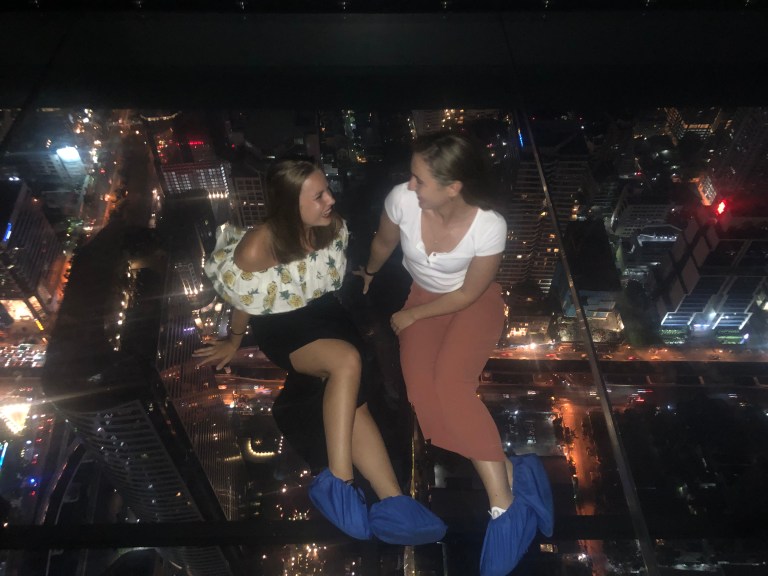
 Snippet in the life of George
Well told.
And what’s that glass floor you’re sitting on?
Have fun 🙂
LikeLike